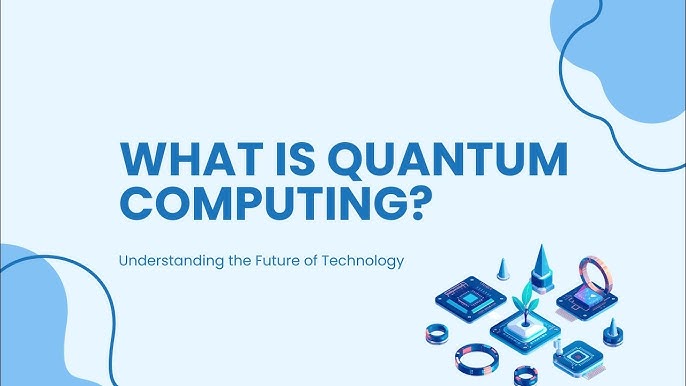

Quantum Computing Explained – A Beginner’s Guide to the Future of Computing
Introduction
Quantum computing is one of the most exciting breakthroughs in modern technology. Unlike traditional computers that process information using binary bits (0s and 1s), quantum computers use qubits, allowing them to perform multiple calculations simultaneously. This revolutionary approach has the potential to solve problems that would take classical computers thousands or even millions of years.
Governments, research institutions, and major technology companies are investing billions of dollars into quantum computing because it could transform industries such as healthcare, finance, cybersecurity, logistics, and artificial intelligence. While the technology is still developing, experts believe quantum computing will play a major role in solving some of the world’s most complex challenges.
1. What Is Quantum Computing?
Quantum computing is a new type of computing that uses the principles of quantum mechanics to process information. Instead of relying on simple binary bits, quantum computers use qubits, which can represent multiple states at the same time through a property known as superposition.
This enables quantum computers to explore many possible solutions simultaneously rather than checking them one after another. As a result, they can solve highly complex mathematical and scientific problems much faster than conventional computers in certain tasks.
2. How Quantum Computers Work
Quantum computers rely on several unique principles:
- Qubits: Unlike classical bits, qubits can exist in multiple states simultaneously.
- Superposition: Allows a qubit to be both 0 and 1 at the same time until measured.
- Entanglement: Links qubits together so that changes in one instantly affect another, regardless of distance.
- Quantum Interference: Helps amplify correct solutions while reducing incorrect ones.
These principles allow quantum systems to process vast amounts of information in parallel, making them suitable for specialized computational problems.
3. Quantum Computing vs Classical Computing
Traditional computers are excellent for everyday tasks such as web browsing, office work, gaming, and software development. Quantum computers, however, are designed for solving extremely complex problems involving optimization, molecular simulation, cryptography, and advanced scientific research.
While classical computers remain essential for most users, quantum computers are expected to complement—not replace—them by handling workloads that are impractical for conventional systems.
4. Real-World Applications of Quantum Computing
Quantum computing has the potential to revolutionize many industries:
- Healthcare: Accelerating drug discovery and medical research.
- Finance: Improving portfolio optimization and fraud detection.
- Cybersecurity: Developing stronger encryption and secure communication.
- Artificial Intelligence: Speeding up machine learning and complex data analysis.
- Logistics: Optimizing supply chains and transportation routes.
- Climate Science: Simulating environmental systems to improve climate predictions.
These applications could significantly reduce processing times for problems that are currently beyond the capabilities of traditional computers.
5. Benefits and Challenges
Benefits
- Exceptional processing power for specialized problems.
- Faster optimization and simulation.
- Advances in AI and scientific research.
- Potential breakthroughs in medicine and materials science.
Challenges
- Extremely expensive hardware.
- Requires ultra-low operating temperatures.
- High sensitivity to environmental interference.
- Limited availability and early-stage software ecosystem.
- Error correction remains a significant technical challenge.
Overcoming these hurdles is essential before quantum computing becomes widely accessible.
6. Leading Companies in Quantum Computing
Several organizations are driving innovation in this field, including:
- IBM
- Microsoft
- Intel
- Amazon Web Services (AWS)
- Rigetti Computing
- IonQ
- D-Wave
These companies are developing quantum hardware, cloud-based quantum platforms, and software tools to advance research and commercial applications.
7. The Future of Quantum Computing
The future of quantum computing is promising. Researchers expect continued improvements in qubit stability, error correction, and scalability. As the technology matures, quantum computers may work alongside classical systems to tackle complex challenges in science, engineering, healthcare, finance, and artificial intelligence.
Although widespread adoption may still take years, businesses and governments are already preparing for a future where quantum computing becomes an important part of technological innovation.
Conclusion
Quantum computing represents a major leap forward in computational technology. By leveraging the principles of quantum mechanics, it offers unprecedented capabilities for solving complex problems that are difficult or impossible for classical computers. While challenges remain, ongoing research and investment are steadily bringing quantum computing closer to practical, real-world use.






Leave a Comment